One of the adages I lived by in my twenties was “drunk words are sober thoughts.” It gets parroted constantly. Reddit’s r/relationships will invoke it any time a relationship is strained by something said six drinks in. And I don’t deny that drunk actions have lasting consequences that need sober repair. But I’ve started to wonder why we accept, almost on instinct, that the words said while drunk are the true ones.
The Romans had their own version, in vino veritas: in wine, there is truth. Sometimes the ancients used it the way we use the modern phrase. The Greek poet Theognis says wine shows a man’s mind the way fire tests gold. But they also used it to mean that wine lowers your guard and you spill your secrets. When Pliny the Elder brings up the saying, he’s in the middle of a list of what drunks blurt out: their secrets, the terms of their wills, the remark that gets their throat cut. The two meanings aren’t the same: the first says alcohol reveals who you are. The second says it reveals what you know, or want, or are afraid of. A secret is a fact you’re sitting on, not your soul.
At some point, the modern phrasing dropped the second meaning and kept the first. “Drunk words are sober thoughts” means you let the mask, not a secret, slip. That smuggled an enormous assumption: there is a mask. Sober you is a performance made for an audience: it is a lie.
Even the ancients who took the drunk word most seriously didn’t go that far. Tacitus says the Germans argued out their biggest questions at feasts on the theory that nobody that drunk can fake anything. Then they took it all up again the next day, sober, and decided. Herodotus says the Persians wouldn’t act on anything serious until it had held up both drunk and sober. The drunk self got a hearing, but it didn’t get the last word.
So why shouldn’t the restraint count as part of the self? Say I’m struggling with my love life and my brother gets engaged to his longtime girlfriend. I feel envy and resentment deep down. Two versions of the night I get the news.
- Sober: I feel the envy and resentment, but then a second thought arrives: “I love my brother, and he deserves happiness.” The envy wanes as happiness floods in. I join the celebration; everyone has a great time.
- Drunk: I feel the envy and resentment. I start to break down. “Why can’t I find love? Why does everyone have good things happen but me?” The envy has spilled over and I’ve made a scene. I still love my brother, but my state has made a fool out of me.
The envy is real in both versions. So is the love. All the drink removed was the ability to hold both at once. I have a hard time believing that the drunken self is the true self in this scenario.
Notice, too, that we only run the adage in one direction. When I drunkenly tell a near-stranger that I love them and that I’d take a bullet for them, that they’re the best person I’ve ever met, nobody calls that a sober thought. My wife goes, “Sorry, he’s a happy drunk.” (Very true!) But the impulse is a sober one. I wrote a blog post in 2015, stone sober, about how I love to tell my friends what they mean to me, especially when I’m drunk. The one time I can prove that drunk words are sober thoughts, with a timestamp, nobody reaches for the adage. Drunk affection gets discounted; drunk cruelty is revealing. So the adage isn’t a theory of alcohol at all. It’s a theory that what’s underneath is worse than what’s on top.
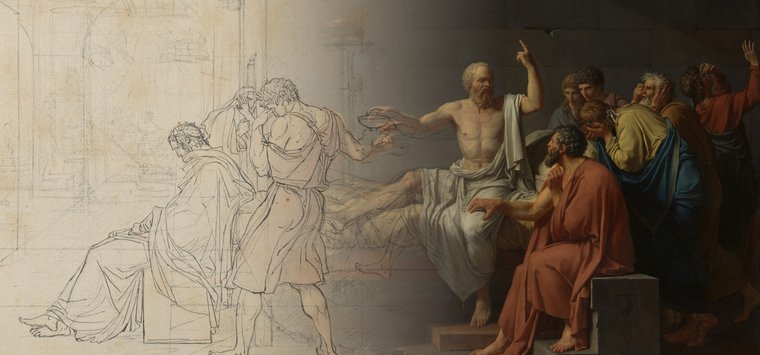
Is the sketch more real than the painting because it’s raw?
I suspect the reason we say yes has less to do with alcohol than with the history of American faith.
Essentialism, the belief that a person is a fixed thing and that behavior is a window onto it, is probably a universal intuition. Children reason this way before anyone teaches them to. The scorpion stings the frog halfway across the river, and everyone already knows the punchline: it was in his nature. But nearly every major moral framework is machinery built to fight that intuition. Aristotle says you become just by doing just things, the way you become a builder by building. Xunzi, a Confucian, says that human nature is bad and goodness is something you build through effort. Jewish tradition teaches that the heart follows the deed. The Catholic Church built a sacrament around penance. Each time, the same approach: character is built, by habit, over time.
The Reformation is the exception, and it knew what it was arguing with. The medieval Church had held together Augustine’s grace, which you’re given, and Aristotle’s habit, which you build. Martin Luther was an Augustinian friar. In September 1517, eight weeks before his 95 Theses, he wrote a different set for debate at his university. One of them is Aristotle’s line turned inside out: we don’t become righteous by doing righteous deeds; we’re made righteous, and then we do them. The next one calls nearly all of Aristotle’s Ethics the worst enemy of grace. Three years later Luther had refined it down to one sentence: good works don’t make a good man; a good man does good works.
Calvin took it to the limit. His God had decided before the foundation of the world who was saved and who was damned, and nothing you did could change that. The verdict had already come in. Human nature was corrupt all the way down; whatever good was in you had been placed, not grown. That left the believer with a problem: how do you know which list you’re on? And how do I know which list my neighbor is on?
The Puritan answer was to read a life for evidence. Good works couldn’t make you one of the elect, but they might be a sign that you already were. Massachusetts Bay made it an institution. Starting in 1631, you couldn’t vote unless you were a full member of the church, and within a few years you couldn’t become a full member until you stood up in front of the congregation and told them the story of your conversion. Your neighbors listened, and then they voted on whether they believed you. A decent life was only evidence. You can’t prove someone is good, after all, only that they’re not. What that produced was anxiety: the restless scanning of your own conduct for proof of a verdict you couldn’t see.
It’s a strange way to relate to your own actions. Everywhere else, the deed is a brick, but here it’s evidence. Your actions don’t build what you are. They reveal what you already were.
Evidence also doesn’t come in sizes. A small bad brick is a small bad brick. A small slip, read as evidence, says as much as a big one. Maybe more, because it was unguarded.
Now do that for five generations. I don’t see why habit would stop working at the scale of a people. A culture that spent a century and a half examining its neighbors for signs of a hidden verdict became a culture that examines its neighbors for signs of a hidden verdict.
The theology didn’t survive. Most Americans couldn’t tell you what predestination means, and the revivalist Christianity that swept the country in the 1800s didn’t care for it. But they were still Protestants. They kept the rule: works are fruit, not root. Their leading man, Charles Finney, was a lawyer with no patience for Calvin’s fixed list. What he kept was the moment: at his Rochester meetings in 1830 he set aside a front pew, known as the anxious seat, for anyone anxious about their soul. You came forward in front of everyone, and the congregation prayed for you to convert on the spot. The revivalists were fierce believers in change. But look at what kind: born again, the altar call, the testimony. The change that counted was placed, not grown: one moment at the front of the room, then told to the congregation as evidence. The culture could picture a bolt of lightning but not a wall going up.
So the way of looking survived after the list was gone. We kept the eye and lost the reasons. For the Puritans, the lapse was your nature and the discipline was God’s grace working in you. Take God out, and the lapse is still your nature, but the discipline has to be something you’re doing, which is to say, an act. That’s the mask.
There’s an old Irish joke. A man says he doesn’t believe in God. “Fine,” comes the reply, “but are you a Catholic atheist or a Protestant atheist?” America is a Protestant atheist: a major culture built almost entirely by the tradition that agreed with gut intuition rather than fighting it. Three assumptions are left standing: what a person does reveals what they are; what they are underneath is probably worse than what they let you see; and if they ever change, it’ll be all at once or not at all.
I was raised Catholic in a part of Texas where that’s the default, went to Catholic school from the start, spent my teenage years into my twenties as a secular materialist, and came back to faith by way of the existentialists. It’s a weird journey. But that’s three vantage points on the same question, and I ended up in the same place from all three. The Catholic one says acts shape the soul. The existentialist one says there’s no soul to show until you’ve acted. Even the materialist one got me there, though it took longer. I couldn’t believe in a free will that ran outside of physics, and I couldn’t believe there wasn’t one, so I landed on compatibilism: my choices are determined, and they’re still mine, and they still feed back into whatever is doing the choosing. Which is just a science-y way of laying a brick.
Those are arguments, though, and I came to them late. What I had first was the air, and it never left. For the stretch in the middle I was the Catholic atheist from the joke: I’d dropped the belief and kept the habits. I know because I was blogging through a lot of it. So when I say a habit can outlast its theology, I’m not guessing.
Here’s what the habits looked like. My family fights. Often, and loudly: screaming matches. Then Christmas comes, and New Year’s, or just a random Sunday, and we’re all there like nothing happened. I have fights with my friends and we get back together. I assumed everybody worked this way until the internet told me otherwise. A fight was never a vote on whether you still belonged. In Massachusetts Bay, the congregation voted.
I’ve screwed up a lot, and I still have good friends. At one point I had to tell my best friend the least flattering thing about me. I’m leaving out what it was, because evidence doesn’t come in sizes. She said, “I’m not friends with part of you. I’m friends with all of you.” That was a redemptive moment for me, but it didn’t feel like being born again. It just felt like friendship. Maybe if I’d grown up further north I’d tell it as my testimony, with a before and an after. As it was, nothing between us changed. Our hangouts stayed the same normal hangouts. The work happened everywhere else, in a hundred small, mortifying moments where I’d catch myself doing it again, mid-sentence, and have to stop and say so out loud. Her grace was a large and beautiful brick that served as a foundation, and then I still had to build the wall. It was much easier to build because of her.
So when I tell you I have a friend who believes some things I find odious, you know which side of this I’ve been on. He believes them for reasons I understand and disagree with, and he is, apart from that, a great friend and a great dude. One by one, everyone else has cut him off. I’m what’s left. The advice I get blows in one direction: cut him loose, protect your peace, you shouldn’t have to carry this. And yeah, I shouldn’t have to. But somebody does, and if I go, the only people left are those who will pull him deeper. If not me, who? The advice assumes that his beliefs reveal what he is, and that what he is, he stays. By that logic, I’m wasting my time. By the logic I was raised on, this isn’t what ends a friendship. It’s the engagement party again: I can hold what he believes and who he’s been to me at the same time, and the advice is to pick one and call it the real him. Somebody once declined to do that to me.
Once you see it, it’s everywhere.
Dating. You either click right away or you don’t. Compatibility is inherent, not grown; if it takes work, it “isn’t meant to be.” Kind of an odd way of putting it, really. Meant by whom? “Meant to be,” “the one,” “soulmates,” “built for me”: the vocabulary of romance is predestination with the serial numbers filed off. Then there’s “the ick,” which lets a single unflattering moment outweigh months of good evidence. The ick isn’t a mood you’re having. It’s a revelation you’ve received. You saw who they really are, and we accept that as a valid reason to leave.
Public life. A bad post from half a lifetime ago can be dug up and treated as news. It doesn’t matter that the author has disavowed it, grown since, or wrote it in a different era. The old post is treated as a glimpse into their soul, and everything else is the coverup. Growth isn’t evidence; it can’t be evidence. It’s just fear of being discovered for what you are, because nobody changes slowly. I have a blog full of things I wrote in my twenties. I cringe at a lot of it and I refuse to take any of it down. It’s the bottom of the wall.
Criminal justice. Our system is built to punish, not reform. It’s a little funny that we call them penitentiaries: places where a person would be brought to penitence and remade. Few believe this anymore. If crime reveals what someone is, there’s nothing left to reform, only contain or dispose of. On paper, a sentence has an end date. Your debt is paid. In practice, you leave as a “felon,” a noun that marks you as one of the damned and follows you into job applications, apartment leases, and even friendships for the rest of your life.
Stories. American pop culture runs on the reveal and the turn.
The reveal is the twist where someone turns out to have been good or evil all along, and everything you watched them do before it gets reread as the mask. The reveal itself is as old as dirt, but what Oedipus finds out in his reveal is a fact: who his parents are. Nobody walks out thinking he was secretly rotten the whole time. It’s the same split as before, a secret versus a soul, and our reveals are the soul kind.
The turn is what wrestling calls the heel turn, or its mirror image, the face turn: a switch of sides that takes exactly one scene. The villain who turns in the last ten minutes usually does it just in time to die. Darth Vader gets a few minutes of being good, and then he dies, because the culture can picture one heroic moment but has no idea what a redeemed person does on a Tuesday. What our stories almost never show is the slow kind, the bricks. And when one does, people lose their minds. Zuko’s arc in Avatar: The Last Airbender is still, nearly two decades later, the standard example of a redemption done right, and the thing people praise about it is that it took three seasons, that he backslid, that he had to choose it more than once. That’s not a high bar. That’s a starving audience.
In 2011, Bethesda released a video game called The Elder Scrolls V: Skyrim. Deep into the main quest, you climb the tallest mountain in the game and meet Paarthurnax, an ancient dragon, who asks you:
What is better? To be born good, or to overcome your evil nature through great effort?
The internet received this as a bolt from the blue. It was screenshotted, quoted, and still gets posted in every “most profound quote in gaming” thread. It is one of the most famous pieces of writing in any video game.
I find this curious, because the question is old. Every confessional tradition has a position on it. Kant and Aristotle would give you different answers, but it wasn’t new to them. This question should be so worn into our culture that a dragon asking it would get an eye-roll. Instead, it got a standing ovation.
I think the answer to “why” is this essay. The question landed as profound because our culture had stopped treating the second option as real. If what you are is fixed and your actions merely reveal it, then “overcome your evil nature through great effort” isn’t one of two possibilities but a coverup with extra steps. Paarthurnax wasn’t asking something new. He was asking something we’d forgotten was a question.
The game knew what it was doing. Paarthurnax isn’t a neutral sage posing a riddle. He was Alduin’s lieutenant in the war that nearly ended humanity, and he has blood on his talons that no amount of meditation can wash off. He also turned, taught humans the Voice that let them fight back, and has spent the thousands of years since on a mountaintop in a permanent blizzard, fighting against his own nature. He tells you as much: not a day goes by, he says, without the temptation to go back to what he was born as. He never denies the nature. Neither did Xunzi, and for that matter neither did Calvin. The fight was never over whether there’s something dark underneath, only whether that’s the verdict. Shortly after you meet him, the Blades, the game’s order of dragon-hunters, demand that you kill him before they’ll help you again. He’s a dragon. He did what he did. The rest is a coverup.
The game makes you choose. A lot of players refused. The quest became notorious for it, and one of the more popular mods for the game exists for the sole purpose of giving you the option to talk the Blades out of it. Put a specific face and a specific history in front of people, and they pick the painting over the sketch.
We keep finding it again, too, and not only in stories. In 1935 two drunks from Vermont started a fellowship that came out of an evangelical movement and then parted ways with it. The movement preached complete victory over sin. Alcoholics Anonymous said you’re never cured, and counted days instead. A few years later a Jesuit turned up at their New York clubhouse to tell Bill Wilson how much his Twelve Steps resembled the Spiritual Exercises of St. Ignatius. Wilson had never heard of him. That’s what happens when a tradition hides the bricks from its own people. They have to keep reinventing them, and every time they do, it lands like a discovery: Zuko, Paarthurnax, a church basement on a weeknight.
This suggests essentialism isn’t a conviction. It’s scaffolding, left standing long after the building came down. We scan for the revealing moment because we were taught to scan, not because we decided that’s where truth lives.
There’s a passage by C. S. Lewis I keep coming back to. He’s answering the idea that good people don’t know what temptation is like, and his reply is that only the people who resist a temptation ever find out how strong it is. You learn the force of a wind by walking into it, not by lying down. Someone who gives in after five minutes has no idea what the next hour would have felt like. The people we call bad have, in that sense, led sheltered lives.
I want to push that image one step further. He’s talking about whether you stand or lie down. But the wind itself isn’t the same for everyone. Some people live their whole lives in a breeze. Others wake up every morning in a hurricane, through no choice of their own: temperament, addiction, history, the particular shape of the temptation. The essentialist view has no instrument for wind. It can only record whether you’re upright. So it will reliably rank the person in the breeze above the person in the hurricane who keeps falling but refuses to stay down, even though the second person is doing something the first has never once been asked to do. The fall tells you about the wind. The rise tells you about the soul. It’s also how you build one.
That’s how I’ve come to think about drunk words. What someone says six beers in doesn’t reveal who they are. It reveals the winds they’ve been walking into. The sober self that was supposed to be a mask is the one doing the walking. And when the moment comes, when someone we love says something ugly, we have more choice than the adage admits about which version of them we’re going to believe.
Paarthurnax never answers his own question. He doesn’t need to. He answers it every morning on the mountain, when he wakes up in the hurricane and stands in it for one more day. Anyone who has watched a friend stay sober one day at a time will recognize the schedule.